
AI: The Reputation Signal · Issue 14
What in-house teams will need from their agencies next
Elif Güvençer ·
I have written in detail about what AI is doing to in-house communications teams. This issue looks at the other side of the table, the agencies, and at how the partnership between the two sides needs to evolve.
I have been the agency pitching the work, at Ogilvy and Edelman, and the client buying it, having built the corporate communications function at pladis and hired and worked with agency partners for years. This issue draws on both views.
My starting point is simple. AI is changing the comms role. And with it, the support in-house teams require from their agencies.
How agencies are responding to AI
First a look at financials. Two-thirds of the top 300 PR agencies grew in 2025, and PRovoke puts overall industry growth at 5 to 6%.
Most small and mid-sized agencies are still working out their answer to AI. The largest firms have moved publicly: Edelman, Burson, FGS Global to name a few, have built or bought their own AI platforms. But as Ruder Finn’s CEO Kathy Bloomgarden put it, “the real differentiator today is no longer access to AI tools. It’s whether organizations can apply and operationalize AI in ways that consistently and meaningfully improve outcomes.”
Where it gets real is how agencies get paid. Every AI conversation is a fee negotiation waiting to happen, because AI is automating work traditionally billed by the hour. WPP’s CEO Cindy Rose has said the time and materials model is “probably not sustainable in the long term”, yet she expects the shift to take “a few years”. Clients may not wait: in a WFA survey of 69 multinationals, 20% have already changed how they pay their marketing agencies because of AI, and 61% plan to.
Much of this is agencies responding to changes they can already see in their clients’ world. The bigger shift, though, is happening in the client’s role itself, and that is what will decide the support clients need next.
The comms role is changing
AI is redefining what communications is for. I wrote about this most recently in Stop asking which AI tools to use: content creation is being commoditised, reputation is increasingly mediated by machines that reach your stakeholders before you do, and media relations has become a triangle with AI in it. The basis of value for comms is moving, and the work is moving with it.
Then there are the expectations inside the business. Leadership teams want to see what AI has delivered, and comms is no exception.
And the money pot is not growing. In the PR 2030 Transformation Study by Earned First, the Institute for PR (IPR) and Ruder Finn Asia, 85% of in-house respondents said external agency budgets were not increasing in 2026 (Earned First).
Most teams will use AI to do the same thing faster, not to rethink what the work should now be. That applies to both sides of the table. This view assumes the same work still has the same value or purpose, which is not the case. Agency and in-house teams both need to think what tasks keep their value, which ones lose it, which ones evolve into something else. And, any efficiency AI creates should be reallocated into upstream work that holds its value, or into the new work AI creates.
Mind the perception gap
The PR 2030 study asked in-house teams about themselves and agencies (referred to as consultancy in the study, to be exact) about their clients (Earned First). Agencies rate their clients’ standing lower than clients do, on almost every measure. Three gaps stand out.
Leadership input. 62% of in-house teams say leadership often or always seeks their input. 34% of agencies say the same about their clients. In-house teams have more influence than their agencies give them credit for.
The rooms that matter. Asked how much each part of the business values comms, the two sides disagree most on legal and the board: in-house teams rate the value those rooms place on comms well above what their agencies think. These are also the rooms where AI governance gets decided. On both sides, finance and IT are seen to value comms least. Finance holds the money pot, IT holds the keys to any tech stack, including the AI tool that you wish to have. If I were leading comms, I would focus on bridging this gap and the agency that helps in-house teams win these rooms is hard to cut.
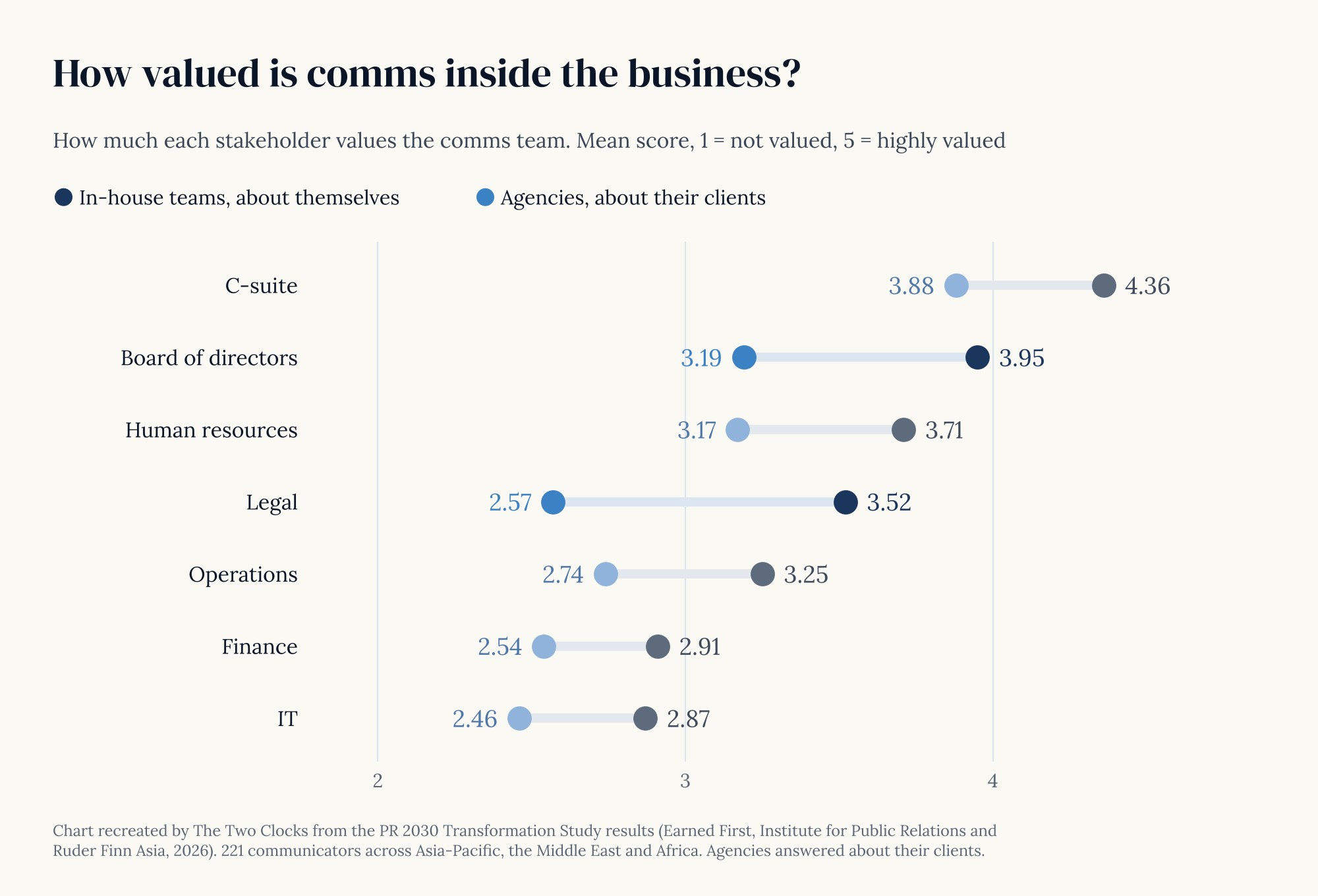
The internal effort. 78% of in-house teams say the business doesn’t understand the value of PR; 36% of agencies see that for their clients. Much of the in-house team’s hardest work happens where its agencies can’t see it.
The elephant in the room is an em dash
The stigma around AI hardened into a tick on the em dash, one of the biggest tells of AI usage. As I wrote in Em dash and proud, AI disclosure carries a trust penalty. Art labelled AI-generated was valued 62% lower than identical work labelled human-made, and in a series of experiments, clients trusted a designer 20% less once the designer disclosed using AI. Meanwhile, the EU AI Act’s transparency obligations came into force in August, so disclosure is increasingly required but penalized. Reveal AI in the work, and the work loses its worth. Reveal AI in yourself, and you lose your standing.
In a client-agency partnership, that trust penalty doesn’t stay abstract. It shows up in scope and in how the work gets priced. If a task that took five hours now takes one, it is better to bring that to the table before the client does, and to decide together where the time it frees up should go.
The same goes for AI more broadly. Where does the client stand on it? How does it fit into the agency’s work? What does the agency add on top of it? What are the guardrails? Raising these early protects the relationship.
Where in-house teams will need support
As the comms role changes, so does the support in-house teams need. These are the areas I see it coming from.
Making the case inside the business. Proving value to the board, finance, legal in the language those audiences use: risk, resilience and growth.
Measurement. Building the attribution between communications activity and business outcomes, which I wrote about in the last issue. It now also has to cover new measures, such as how the organisation appears in AI answers and its impact on the business.
AI capability. Deciding whether to build it in-house, with support on guidelines, training and workflow design, or to use an external partner’s tools.
AI governance. Shaping the AI decisions as opposed to being called in to communicate them.
Spotting what AI breaks. A customer agent saying something the company would never sign off, an answer on an AI engine that misstates the company’s position, content authenticity in a sea of mis- and disinformation to name a few.
If you are reading this from the agency side, here are three questions to start with:
- Which of your clients’ internal pressures do you know in detail, and which are you assuming?
- On each account, where has the time AI saves if any, gone: margin, a discount or new work?
- Have you talked to each client about AI and fees, or are you waiting to be asked?
See you at AMEC AI Day
I’m speaking at AMEC AI Day in London on 4 November about AI agents being your new spokespeople, and how to media train them. If you’re around, come and say hi. I’ll be listening as much as speaking, and I’ll share what I hear in a separate post.