
AI: The Reputation Signal · Issue 15
Notes from AMEC AI Day and a prompt to media train your AI agents
Elif Güvençer ·
I had a keynote at AMEC AI Day this week. In my last issue I said I would share what I hear. Here it is.
This isn't a summary of who said what. It's what stuck with me, with my own views layered in. I am sure there are other recaps if you search #AMECAIDay on LinkedIn.
The spokespeople stepping back
Ben Verinder spoke about AI and risk. A few things he said are especially important.
The first was his example of company spokespeople who no longer want to show their faces in public out of fear of deepfakes. This is a valid concern. It is also a serious issue. Leadership communication is an important part of building and maintaining corporate reputation. People want to see the faces behind companies. If spokespeople won’t come forward, who will tell the story?
The second: you can't mop up AI slop. You have to be upstream to stop it getting there in the first place. Ben also covered companies failing to communicate the employment impact of AI (Ford rehiring engineers to fix what AI broke, and AI-washing of job cuts that were already happening). He also talked about organisations accused of fake news having to defend themselves when the news is not fake! The well of truth is being poisoned, and cleaning it after the fact is a losing game.
Reputation is managed at the input level
Most of the day was about GEO and AI visibility, the gravitational pull of reputation management in today’s day and age. The ground is still noisy, and every session discussed a different angle.
Here is what I think:
AI compresses your reputation to a summary. Before you say a word as a company, AI has already handed over a version of you to anyone who asks. And that summary is now a commercial gate. It decides whether you make the cut on a buyer's shortlist.
It is evolving reputation management from a relational model (one where you build relationships with the right people and mediate your message) to an architectural one, which you build one signal at a time. From your website to your media coverage, they are all signals. This is what I call signal architecture.
Who you are, and the message you want to give the outside world, has to survive machine compression.
“The best car in the world” appeals to a human. It doesn’t appeal to a machine. A machine needs substantiated facts underneath the claim. It says show me, don’t tell me.
There is a challenge of coordination here: the picture AI puts together is not painted by a single department. Every department does its job on its own surface and optimises it. What nobody reads is the whole. That used to be manageable. Now you have a synthetic intermediary able to read that picture and distribute it to anyone who asks.
Marketing and corporate communications are becoming increasingly fluid, and they have to collaborate on AI reputation. They are not the only ones; any department that puts content out into the world proactively, or indirectly causes content to exist as a byproduct of its work (e.g. a compliance issue), has to be part of the conversation.
It's an organisational design question before it's a measurement one. I was pleased to hear Martin Schulze come to the same conclusion I did.
Andrew Bruce Smith made a related point in his closing keynote: measure the claim, not the story. The story gets thrown away. The claim survives, or it doesn’t. He also called AI citations the next AVE. There is definitely a risk of them being seen as such.
Can agents hack a reputation?
Paul Stollery from Hard Numbers asked this and sadly the answer is yes. Right now, I, with a Claude subscription and a vendetta against a company or a person, could orchestrate that very easily.
Every stage of an attack already exists. One agent maps what AI says about you. Another finds where the content is thin. Another mass-produces content that looks neutral but isn’t, and another seeds it everywhere the engines look. Others test and maintain it. The only new part is pointing them all at a single target. Chilling, right?
In my view, thin or inconsistent signals are an open door. If you haven't created a signal architecture that defines who you are accurately and credibly, in quality and volume, someone else can easily hijack your reputation, at scale.
Talking about online reputation, enter narrative intelligence
AI breaks the chain between reputational event and outcome. Communications teams increasingly face risks that come from the system itself (deepfakes, prompt injections…), where you may not be able to reproduce the chain of events properly, or not fast enough. Crisis mitigation is going to have to shift gears from explaining to responding. You might not have all the facts, but you can talk to what you are doing about it.
Narrative intelligence can give comms the upper hand, at least in some areas. Repsense showed how a narrative no longer lives on one platform. It gets seeded in Telegram channels, repackaged on TikTok, argued out in comment threads, then echoed by mainstream press. Repetition beats reach. The feed, not the front page, decides what people see.
The skill isn't spotting every narrative. It's separating the ones that matter from the ones that are only loud, before they become an issue.
AI saved time… did it really though?
Amar Vyas from M&C Saatchi Fluency put up a simple but super striking slide. Ten hours of human work becomes two hours of AI production plus eight hours of verification. If AI saves eight hours and creates eight hours of checking, what have we gained?
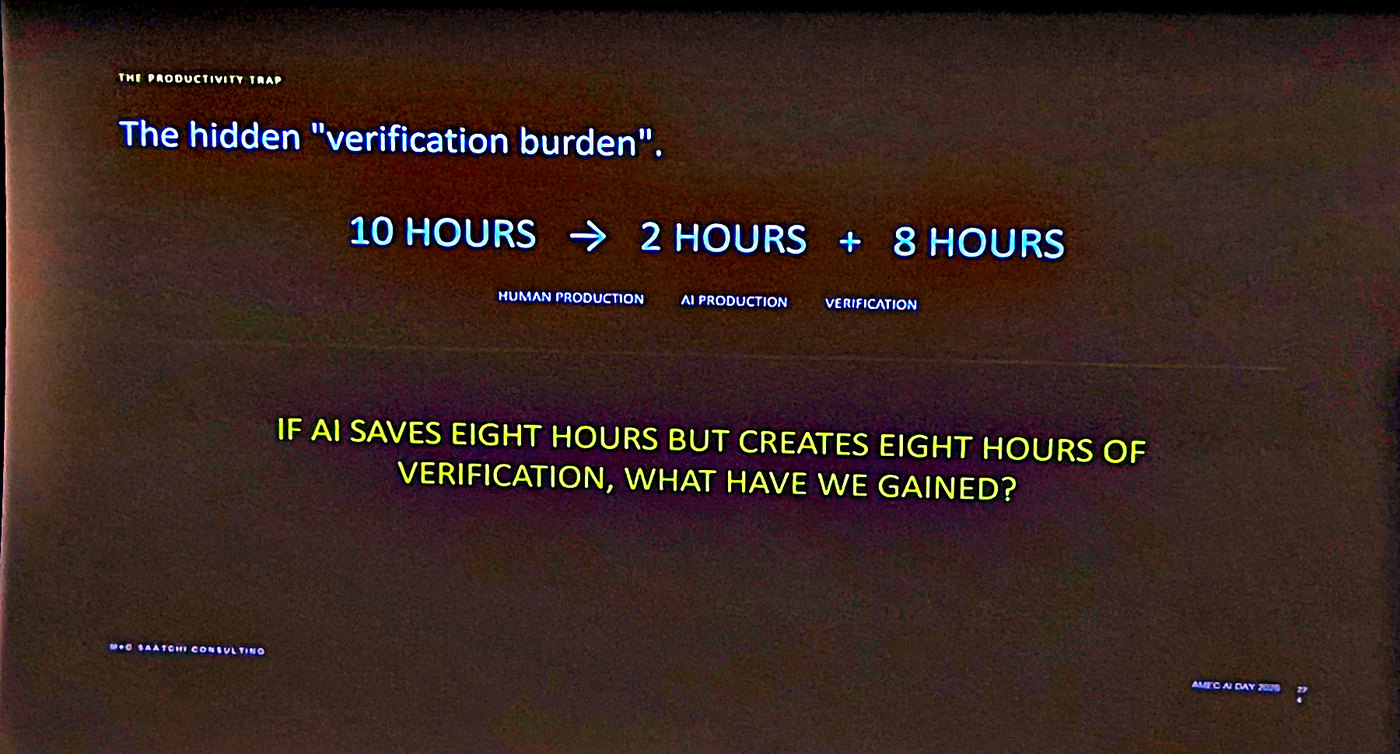
Time saved that gets swallowed by checking was never a saving. Time you save only really counts if it goes into work that holds its value. So before attempting to do the same thing faster, you should be asking what the work should be in the first place. This is where I start my strategy advice to the comms leaders I work with. What is the role of communications when AI sits between you and everyone else?
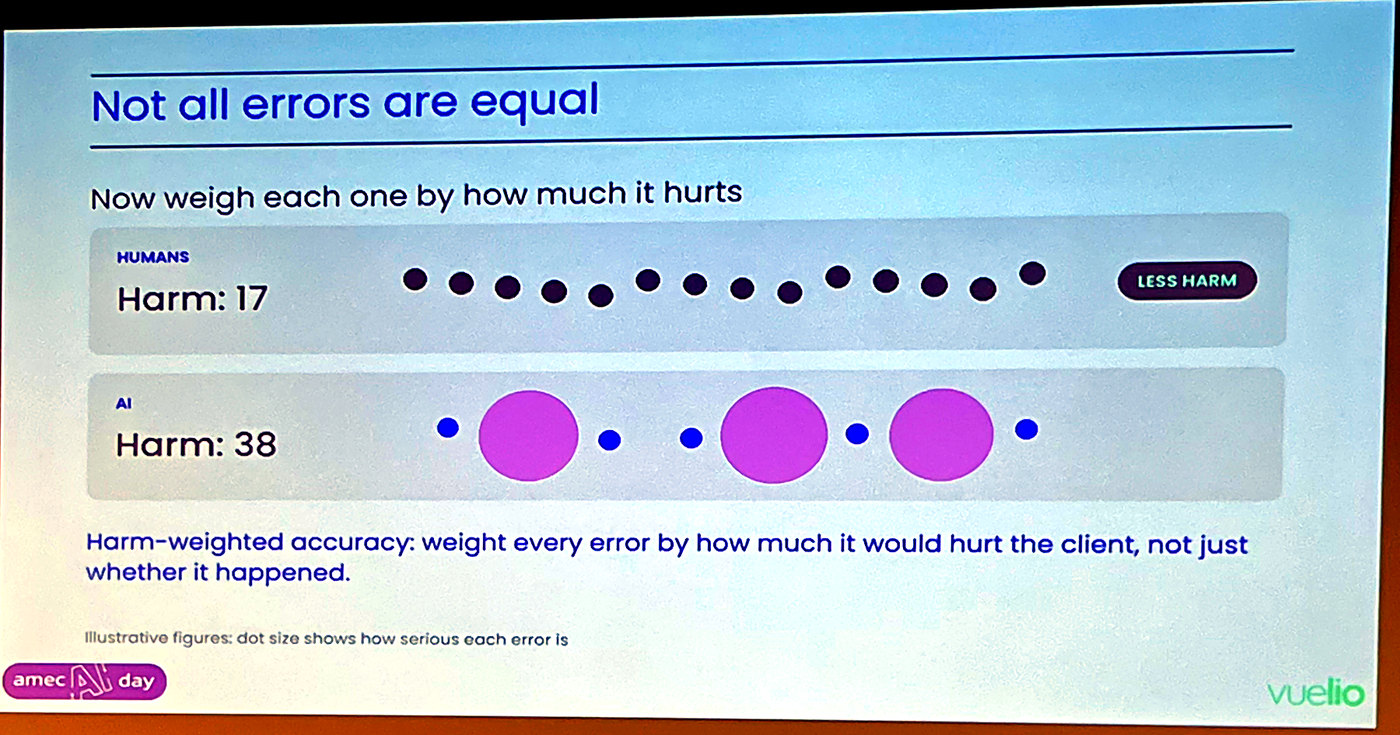
Vuelio’s panel added a twist on checking AI’s homework. Humans aren’t the gold standard. They make mistakes too, but how serious the harm is when a mistake is made needs to be taken into account. In their illustration, AI made fewer errors than humans, eight against fourteen, but its errors did more than twice the harm.
And there’s another, more subtle risk: complacency. This was raised by many speakers. You start by checking AI’s homework thoroughly, you see it does a great job, so you get complacent and check less and less. Underneath this, there is a gradual loss of judgement. Sonya Cullington works in this gap between confidence and competence in AI usage. You might check out her work if it resonates.
AI’s impact on entry-level roles is TBC, but students are doing really interesting things with it
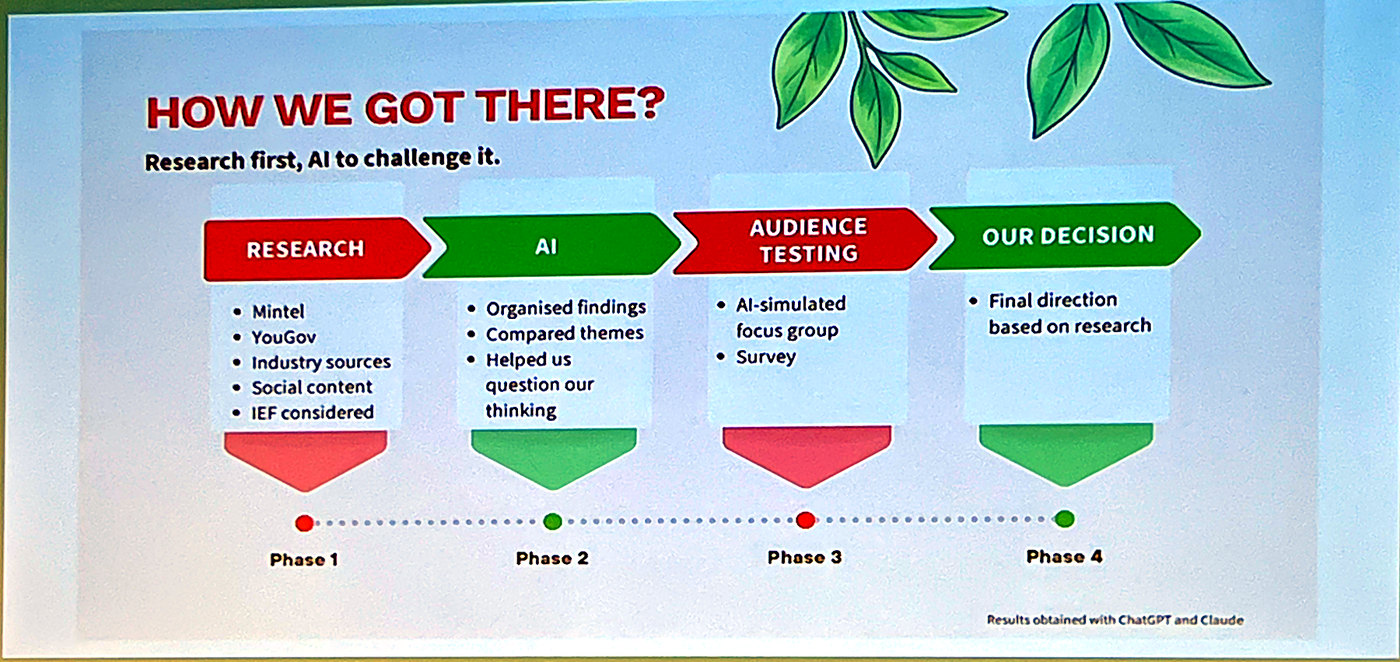
The student panel was one of my favourite sessions. One of the projects did research with synthetic audiences. The process was research first, AI to challenge it. They started with Mintel, YouGov, industry and social sources, used AI to organise the findings and question their own thinking, then ran AI-simulated focus groups and cross-checked them against a real survey on Gen Z before making a decision.
Agents as teammates, agents as spokespeople, agents everywhere
Two views of agents were brought up through the day.
The first was agents as teammates. Comms teams are building synthetic colleagues one specialist at a time: a daily news scan, a brand-voice checker… As we move from asking AI something to delegating work to it, the value moves to briefing, judging and checking its work.
The second view was mine: agents as spokespeople.
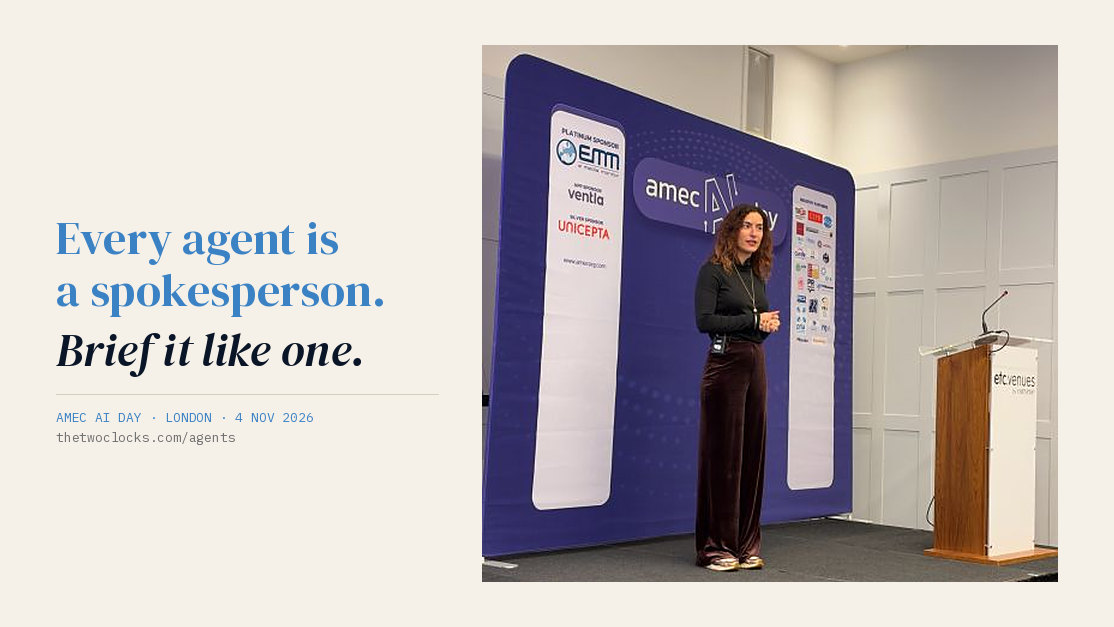
My argument is simple: you would never put your CEO in front of a journalist without media training. Agents should be no exception. Right now, they are talking all day, every day, to whoever shows up (e.g. answering customer questions, screening candidates, talking to suppliers) with no spokesperson briefing.
The failure mode resulting from that ranges from agentic cacophony (three agents giving three different answers to the same question) to an agent causing a full-blown reputational crisis. See DPD, where the agent swore at a customer and wrote a poem about what a terrible delivery firm DPD is.
Soon we will have 20, 50 agents, configured by different teams across markets, speaking on behalf of the same company. Who briefs them? What happens when the position on a topic is not the same across markets? Who reconciles when the local and corporate agents disagree?
The answer to all these questions is a machine spokesperson matrix and briefing system.
You do not need to solve all this now. Here is how you can get started: four questions to answer this week and a mock interview for your agents.
Use the prompt on the link below to create a mock interview. Run the interview on any agent that speaks on behalf of your organisation and see how your agent deals with reputationally sensitive questions.
Click here to access the prompt to media train your agents and four questions to ask this week
Predictions for 2027
Andrew closed the day with six predictions and asked us to rate them come next November. I’m keeping the list.
- Most comms teams will run at least one agent on a recurring measurement task.
- AI citation counts become the new AVE, and the industry has to call it out.
- Stakeholder-lens analysis replaces single sentiment scores in serious evaluation.
- Media intelligence vendors are judged on their data and connectors, not dashboards.
- Calibration statements become standard in evaluation reports and RFPs.
- The skills gap, not the tools gap, becomes the industry’s biggest AI problem.
I’d add a seventh: briefing agents (the reputation protocol) becomes a named communications responsibility, with an owner.
I work with companies on how to brief their agents. Don’t wait until your agent swears at a customer to build the machine spokesperson matrix and briefing system. Message me here if you want to get on that!
Over and out on #AMECAIDay.